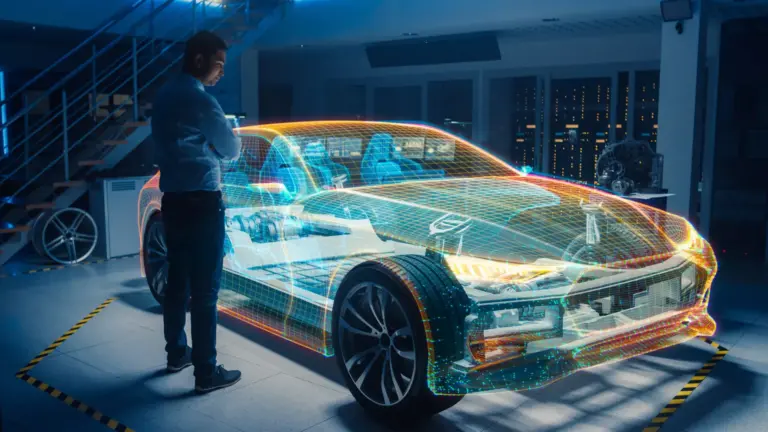
Modern passenger vehicles are highly sophisticated computers on wheels, executing millions of calculations every second to ensure comfort, efficiency, and survival. Yet, when the average driver slides into the cabin, turns the ignition, and navigates through daily traffic, the immense engineering complexity beneath their fingertips is entirely invisible.
Features that once required decades of rigorous laboratory experimentation, aerospace-grade computing power, and radical physics paradigms have quietly transitioned into standard, expected equipment. We treat them as mundane design choices rather than the monumental technical achievements they truly are. By peeling back the layers of everyday automotive technology, we uncover the brilliant engineering marvels that have completely transformed the act of driving.
The Crumple Zone: Managing Kinetic Energy Through Controlled Destruction
For the first half of automotive history, the prevailing safety philosophy was rigidity. Automobile manufacturers believed that building a car as strong and unyielding as a tank was the ultimate way to protect its occupants. This intuitive assumption proved catastrophically wrong. In a high-speed collision, an unyielding chassis stops instantaneously, transferring the lethal kinetic energy directly through the cabin and into the human bodies inside.
The Innovation of Deflection
The paradigm shifted entirely with the invention of the crumple zone. Automotive engineers realized that to save lives, the vehicle itself had to sacrifice its structural integrity. Crumple zones are deliberately designed areas at the front and rear of a vehicle that are engineered to deform, buckle, and collapse in a highly controlled sequence during an impact.
Extending Impact Duration
By lengthening the time it takes for a vehicle to come to a complete stop by even a fraction of a second, the crumple zone dramatically reduces the peak deceleration forces acting on passengers. The energy of the crash is consumed by the bending of specialized high-strength steel and aluminum structures, wrapping a protective cocoon around the rigid safety cell of the passenger cabin. Every time a modern car is completely totaled in an accident yet the passengers walk away with minor bruises, it is a direct testament to this masterclass in kinetic energy management.
Antilock Braking Systems: Staying on the Edge of Friction
Stopping a vehicle weighing several thousand pounds on a rain-slicked highway requires an intricate dance with the laws of physics. Under heavy, panicked braking, a vehicle’s tires can easily lose traction and lock up completely. Once a tire stops rotating and begins to skid, the driver loses all steering control, turning the automobile into an unguided projectile.
The Computational Pulse
The development of the modern Antilock Braking System solved this fundamental hazard. The system relies on wheel speed sensors that continuously monitor the rotational velocity of each individual tire. If the system detects that a wheel is about to stop spinning entirely while the vehicle is still moving, it intervenes at an astonishing speed.
Modulating Hydraulic Pressure
The electronic control unit modulates the hydraulic brake pressure to that specific wheel, pulsing the brakes up to fifteen times per second. This rapid modulation allows the tire to sit precisely at the absolute threshold of maximum braking friction. By preventing the skid, ABS ensures that the driver can actively steer around obstacles even while burying their foot on the brake pedal, completely altering emergency collision avoidance.
Electronic Fuel Injection: The Hyper-Optimized Internal Combustion
For nearly a century, the carburetor was the mechanical heart of the internal combustion engine. It was an intricate, entirely analog web of tiny tubes, jets, and floats designed to mix air and fuel together based on engine vacuum. While brilliant for its time, the carburetor was inherently imprecise, highly sensitive to changes in weather or altitude, and prone to wasting immense amounts of fuel.
Real-Time Atmospheric Adaptability
The transition to Electronic Fuel Injection brought engine management into the digital age. Modern engines utilize a complex array of sensors to measure exact intake air volume, engine temperature, throttle position, ambient atmospheric pressure, and exhaust oxygen content.
Microscopic Fuel Delivery
A centralized engine control unit processes this data instantly, calculating the precise microsecond duration required to spray an atomized mist of fuel directly into the combustion chamber. This optimization happens cycle by cycle, thousands of times a minute. The result is an engine that starts instantly in sub-zero temperatures, self-corrects for high altitude mountain passes, extracts maximum horsepower from every drop of fuel, and reduces harmful exhaust emissions to a fraction of historic levels.
Interconnected Automotive Miracles
Beyond the heavy mechanical systems, a host of other invisible marvels collaborate harmoniously during every single commute to elevate the driving experience.
-
Variable Valve Timing: Instead of operating on a fixed mechanical cycle, modern engines dynamically shift the opening and closing timings of their internal valves on the fly. This enables an engine to behave like an ultra-efficient commuter motor at low speeds and instantly transform into a high-performance sports engine during highway acceleration.
-
Tire Pressure Monitoring Systems: Utilizing minute, wheel-mounted radio frequency transmitters, these systems continuously gauge the internal air density of your tires. This preventative tech preserves fuel economy, prevents catastrophic highway blowouts, and ensures optimal tire contact patches without requiring manual gauge checks.
-
Laminated Acoustic Glass: Windshields are no longer simple sheets of glass. They are complex sandwiches composed of two layers of glass bonded together by a specialized, acoustically dampening polyvinyl butyral interlayer. This thin acoustic barrier reflects exterior wind and tire frequencies away from the cabin, while ensuring the glass does not shatter into dangerous shards during an impact.
Frequently Asked Questions
How does Electronic Stability Control differ fundamentally from an Antilock Braking System?
While ABS strictly prevents wheels from locking up during linear braking, Electronic Stability Control is designed to correct lateral skidding and loss of steering control during turns. ESC utilizes yaw rate sensors and steering angle indicators to detect if a car is spinning out or sliding wide. It automatically applies braking pressure to individual wheels and reduces engine power to pull the vehicle back onto the driver’s intended path.
Why did it take so long for Crumple Zones to become standard if the physics behind them is so straightforward?
The implementation of crumple zones required massive advancements in metallurgy and supercomputer structural modeling. Engineers had to develop specialized high-strength steels that could be stamped into highly specific geometries capable of folding predictably under immense stress, while ensuring adjacent passenger cabin pillars remained absolutely rigid.
What is the engineering purpose behind the black dots found around the edges of a windshield?
Those black dots are called frits. They are made of an ultra-durable ceramic paint baked directly into the glass. The frit serves multiple engineering purposes: it provides a rough texture for the polyurethane adhesive to bond the windshield securely to the car frame, blocks damaging ultraviolet radiation from degrading that adhesive over time, and visually hides the structural glue lines from the outside.
How do modern vehicles manage to keep passenger cabins quiet despite moving at high highway speeds?
Cabin serenity is achieved through complex aerodynamics and acoustic isolation materials. Engineers utilize virtual wind tunnels to eliminate sharp body angles that generate air turbulence. Beneath the interior panels, vehicles are lined with engineered liquid-applied sound deadeners, micro-porous fiber mats, and double-walled rubber door seals designed to absorb and deflect low-frequency road vibrations.
How do smart keyless entry systems function securely without draining the car battery?
Keyless entry systems utilize a highly efficient, low-frequency localized radio network. The vehicle continuously emits a low-power ping. When your key fob enters a specific close range, it wakes up, processes an encrypted rolling security code, and transmits back an authentication signal. Because the communication relies on short bursts of localized data, standby power consumption remains virtually unnoticeable.
What allows modern automatic transmissions to shift gears smoothly compared to older vehicles?
Older automatic transmissions relied entirely on internal hydraulic fluid pressure changes to force shifts. Modern transmissions use highly sensitive electronic solenoids controlled by a computer that communicates directly with the engine. When a shift occurs, the computer momentarily dials back engine torque for a millisecond, allowing the internal clutch packs to engage seamlessly without any physical jerking motion.
How does a modern vehicle engine adjust itself automatically to prevent damage from poor quality fuel?
Modern engines are equipped with highly sensitive acoustic sensors called knock sensors. If you put lower-grade fuel into an engine designed for premium fuel, it can cause erratic premature explosions inside the cylinders, known as engine knock. The knock sensor detects the unique structural frequency of this vibration instantly, causing the engine computer to automatically retard the ignition timing to eliminate the risk of internal mechanical damage.